Your Living Room Is a Better Fitting Room Than Any Store
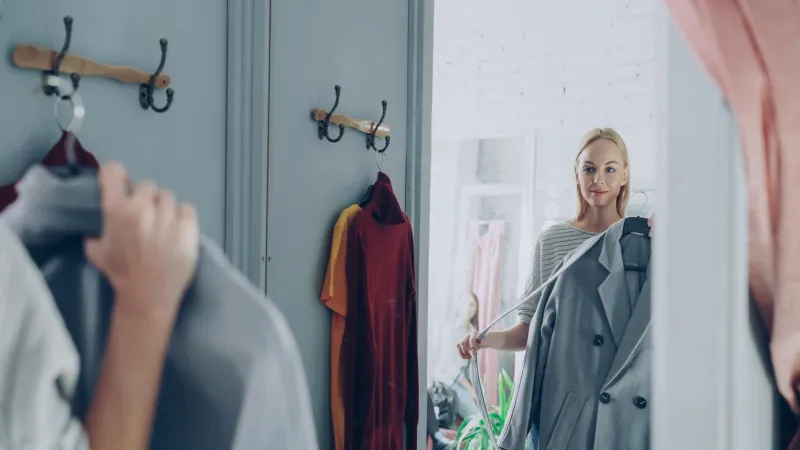
Let's be honest about what happens in a store fitting room. You're wedged into a closet-sized space under lighting that makes everyone look slightly ill, you've got three other items draped over the door, and somewhere outside a salesperson is doing that thing where they knock and ask how everything's going before you've even gotten your second shoe off. It's not exactly an environment built for thoughtful decision-making.
And yet, that's where most of us decide whether to spend $80 on a pair of jeans.
Shopping has changed enormously over the last decade — especially with the rise of direct-to-consumer brands and online retail that ships straight to your door. But the way most people evaluate clothing hasn't kept up. Whether you're buying in-store or ordering online, there's a better method. It's called home fit-testing, and once you try it, going back to the cramped fluorescent box feels genuinely absurd.
Why Store Fitting Rooms Work Against You
Retail environments are engineered with a single goal: get you to say yes. Fitting room lighting is often warm and flattering in premium stores, or harshly unflattering in budget ones — neither of which reflects your actual life. The mirrors are frequently positioned to show you only one angle. There's no room to sit, bend, or move the way you actually move throughout a day.
More importantly, you have zero context. You're standing in a beige box with no sense of what you'd actually wear this shirt with, whether it works for the office or just looks like it might, or whether it's going to pull across the shoulders after two hours of sitting at a desk.
Research on decision fatigue and purchase regret consistently points to the same pattern: the more rushed and context-free a purchase decision is, the more likely you are to regret it later. Fitting rooms — with their inherent pressure and artificial environment — are basically regret machines.
What Home Fit-Testing Actually Looks Like
The concept is simple. Instead of making your final call in the store or immediately after opening a package, you build a small, intentional try-on ritual at home. It doesn't require a fancy setup. It just requires a few deliberate choices.
Get your lighting right. Natural daylight is the gold standard. Try clothes near a window during the day before committing. If that's not possible, a ring light or a neutral-temperature bulb (look for something around 5000K on the packaging) gives you a much more honest read than the warm glow of a bedside lamp.
Use a full-length mirror — and then move away from it. A full-length mirror is non-negotiable. But here's the part most people skip: step away from it. Walk across the room. Sit down. Reach up like you're grabbing something off a high shelf. The way a piece of clothing moves with your body matters more than how it looks standing still in a mirror.
Wear your actual base layers. This sounds obvious but it's easy to forget. If you're trying on a blazer, wear the kind of shirt you'd actually wear under it. If it's a pair of pants, put on the shoes you'd realistically pair them with. The whole outfit ecosystem matters, and evaluating pieces in isolation is how you end up with things that technically fit but never get worn.
Give it the sit test. Sit in a chair for five full minutes. Work at your desk. Lounge on the couch. Does the waistband dig in? Does the shirt untuck? Does the fabric pull in weird places? Clothes that only look good standing up are half the clothes you own and none of the ones you actually reach for.
The Psychology Behind Why This Works
There's a well-documented phenomenon in behavioral economics called the endowment effect — the tendency to value something more once we feel like we own it. Retailers know this. It's part of why generous return policies exist: getting the item into your home increases attachment, which reduces returns even when customers technically have the option.
Home fit-testing flips this to your advantage. By deliberately slowing down the evaluation process and introducing real-world context, you're making a decision based on how the item actually fits your life — not just how it looks in a moment of retail excitement. You're also giving yourself permission to say no after you've already said yes, which takes the pressure off the initial decision and actually leads to more confident purchases.
People who regularly home fit-test report fewer returns, less closet clutter, and a stronger sense of personal style over time. That last one might seem like a stretch, but it makes sense: when you're paying attention to what genuinely works on your body and in your lifestyle, you start to notice patterns. You learn things about yourself as a shopper that no algorithm can tell you.
Making It Work for Online Shopping
Home fit-testing is especially powerful when you're buying online — which, let's face it, is how most of us shop now. The key is treating your delivery like a fitting room appointment rather than a package to tear open and immediately decide on.
Set aside actual time for it. Clear a space. Have the rest of your outfit ready. Don't try things on at 11pm after a long day when you're too tired to care either way. And don't make a final return decision immediately — give yourself at least one wear or try-on in the morning, when you're fresh and your judgment is clearer.
One practical tip: take a photo. Sounds simple, but seeing yourself in a photo rather than a mirror gives you a different perspective. It's closer to how other people see you, and it's easier to evaluate proportions and overall silhouette objectively.
The Bigger Picture
Shopping smarter isn't about spending less — it's about spending better. A home fit-test setup costs you nothing but a little time and intention. What it gives back is a wardrobe full of things that actually work, a return rate that doesn't make your credit card statement look like a revolving door, and the quiet satisfaction of knowing that what's hanging in your closet belongs there.
The fitting room was never really built for you. Your home is. Use it.