The Donation Bin Has a Long Memory: Following Your Old Clothes Past the Drop-Off
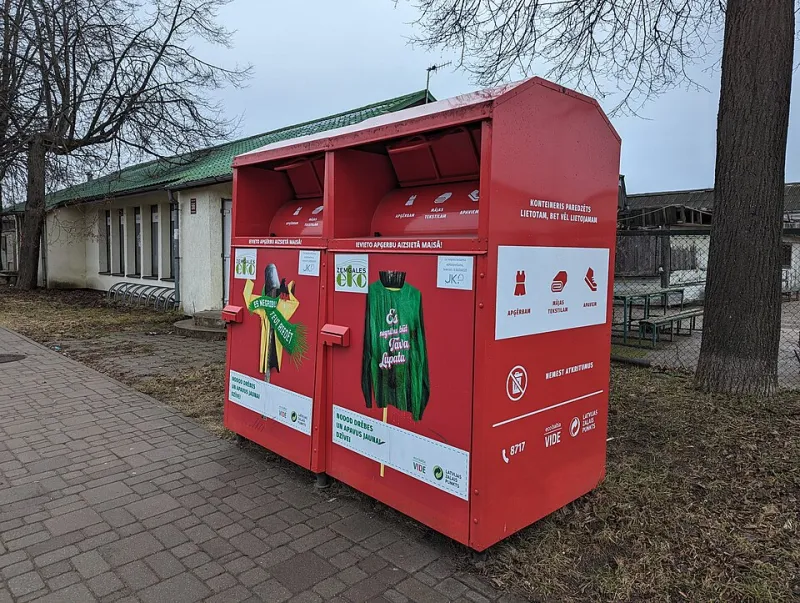
Photo: Андрей Романенко, CC BY-SA 4.0, via Wikimedia Commons
The donation bin is one of the most satisfying objects in modern life. You fill a bag with clothes you no longer wear, drive it to a parking lot, and slide it into a metal chute. The bag disappears. The closet gets lighter. For a moment, the transaction feels morally complete — as if the clothes have been returned to some larger cycle and will now become someone else’s useful wardrobe.
Sometimes that’s true. Often it’s more complicated. The US textile donation stream is part charity, part sorting business, part export trade, and part waste management. Understanding that stream won’t make you a cynic, but it will make you a sharper donor. The bin is not a magic eraser. It’s a doorway into a system with its own economics.
What happens after the chute
Most donation bins are operated by charities, for-profit thrift chains, or contractors that collect on behalf of nonprofits. The clothes are picked up, taken to a warehouse, and sorted. Workers separate items into rough categories: sellable in a thrift store, potentially sellable after grading, recycling-grade fiber, and trash.
That first sort is brutal. A stained T-shirt, a single sock, a fast-fashion dress with a broken zipper — these items are not valuable enough to clean, repair, or merchandize. They may still be “donated,” but donation doesn’t guarantee reuse. It guarantees handling. Handling costs money. Sorters make fast decisions about what can earn more than it costs to process.
The best items go to thrift store floors. Some are sold in bulk to other retailers or online sellers. Some are graded by season, style, and quality, then baled and sold to exporters. A portion becomes wiping rags or insulation fiber. A portion is incinerated or landfilled. The exact split varies by operator, region, and market conditions, but the principle is the same: donation is a sorting funnel, not a guarantee of a second life.
The export story is not a loophole
A lot of US donated clothing leaves the country. Bales of used garments are sold to importers in Latin America, Africa, Asia, and Eastern Europe, where they are sorted again and sold in local markets. For many people in those markets, secondhand clothing is affordable and useful. For local textile industries, the flood of cheap imports can be disruptive. Both things are true.
The export market is also not a bottomless pit. When global demand for used clothing softens, bales pile up. When a receiving country restricts imports, the stream has to go somewhere else. The result is that even “donated” clothes can become a waste-management problem when the economics stop working. The bin is not a solution to overproduction. It’s a release valve.
The recycling myth
Textile recycling sounds like a clean answer: turn old clothes into new fibers. In practice, mechanical recycling usually shortens fibers, which makes them weaker. Many recycled textiles become lower-value products — insulation, wiping cloths, padding — rather than new clothing. Chemical recycling exists, but it’s not yet a large-scale answer for the mixed, dyed, blended fabrics that dominate the donation stream.
That’s why “recycle” is often the least accurate word on a donation bin. The hierarchy is more like: reuse first, repair second, resell third, recycle fourth, dispose last. If a garment is still wearable, the best outcome is that someone wears it. If it’s not wearable, the best outcome may be a purposeful downcycle — but that’s not the same as a closed-loop fashion system.
Donate better, or don’t donate at all
The most useful question before you donate is not “Is this still in one piece?” It’s “Would I give this to a friend?” If the answer is no, a charity bin probably isn’t the right destination. Donation is not a place to offload guilt, broken zippers, or clothes that smell like a basement.
A better sequence:
- Repair first. A missing button, a loose hem, or a small stain is often fixable. A tailor or a basic sewing kit can extend a garment’s life by years.
- Resell what has value. Online resale platforms, consignment shops, and local buy-sell groups can turn unworn items into cash or credit. It takes more effort than a bin, but it keeps the item in use.
- Swap with people. Clothing swaps are a low-cost way to move pieces to someone who will actually wear them. You get something new to you, and the garment avoids a warehouse sort.
- Donate intentionally. If you donate, give clean, wearable items to a specific organization with a clear mission. Ask what they accept. Get a receipt if you plan to itemize deductions on your federal taxes. Keep a simple record of the items and their condition.
- Use textile drop-offs for textiles. If a garment is truly worn out, look for a municipal textile recycling program or a store take-back program rather than a charity bin.
The donation bin is not the villain here. It’s a convenient tool that has been asked to solve a problem much bigger than itself: a fashion system that produces enormous volume and treats disposal as an afterthought. You can still use the bin. But use it last, not first. The clothes you drop off have a long journey ahead, and the most honest thing you can do is make sure they deserve to take it.